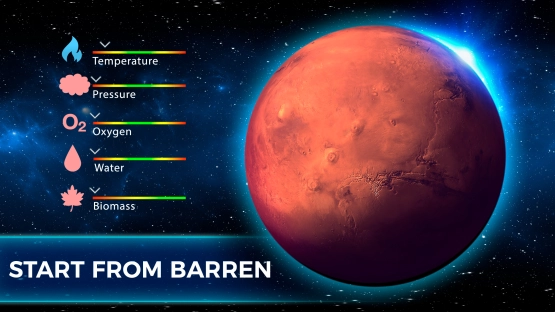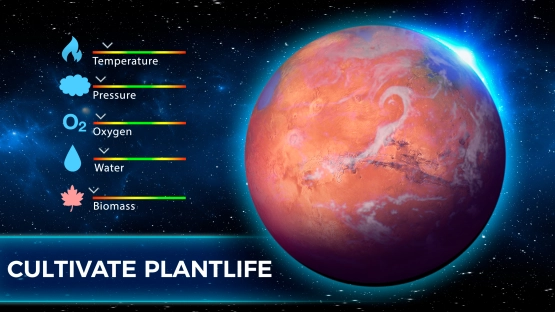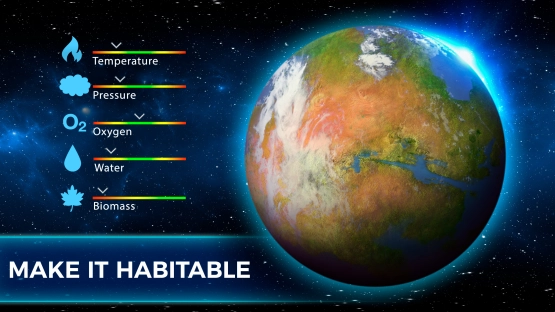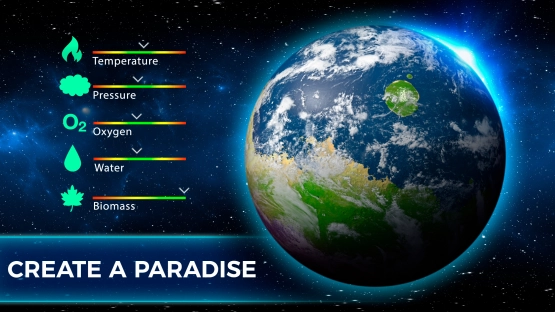
Mars starts dead. Frozen CO2, no breathable air, radiation everywhere. Your first dome goes up with twelve colonists inside. The atmospheric processor chews through resources faster than you thought possible. Water extraction runs at half capacity because you’re short on funding. It takes about twenty minutes of real time before the temperature gauge ticks up even one degree. And that’s the early hours: watching numbers crawl while you decide whether to dump credits into oxygen production or risk it all on an orbital mirror that might speed up the thaw.
NASA Data Running the Background Math
Not the vague sci-fi version where you click a button and suddenly there’s grass. Temperature, atmospheric pressure, sea level, oxygen percentage, biomass—all tracked separately, all interdependent. Crank up the heat too fast and your ice caps melt into floods. Seed forests before the air’s breathable and they die off in waves. But there’s also a stats page that reads like a mission control dashboard, and honestly it gets dense. The modded version includes full terraforming metrics pulled from actual planetary datasets that update every few seconds of simulation time.
Forty Planets and a Lot of Waiting
You’re not stuck on Mars. Venus, Mercury, moons around Jupiter and Saturn, exoplanets way outside the solar system—each one comes with different starting conditions. Some have alien life already there. You get to choose whether to cooperate or wipe them out for easier expansion. The modded version removes the money bottleneck. So instead of grinding the same early upgrades for hours, you can test riskier strategies or just build the megacity you actually want without waiting on another mining facility to finish. And that’s where it clicks, because the base game wants you to replay tutorial-level decisions every time you start a new world. Mars takes twelve hours to get breathable if you’re aggressive with oxygen generators.
Cities That Take Hours to Grow
This isn’t a fast game. Terraform progress happens in chunks measured by real-world minutes, sometimes longer if you’re not spending premium currency to speed it up. And cities expand one district at a time. Watching population tick from a few hundred to a few thousand feels slow even when things are going well. Venus stays at 400°C for the first hour even with three solar shades deployed.